CRM, CMS and ERP Software Solutions

CRM, CMS and ERP Solutions Designed to Work as One System

Three platforms govern most of what a business knows about itself. The CRM holds the demand. The ERP holds the operation. The CMS holds what you say to the market. In most organisations they were bought at different times, by different departments, from different vendors — and nobody owns the space between them. That space is where forecasts stop matching reality, where the same customer exists three times, and where a team of capable people spends its week reconciling systems instead of running the business. BrandReturns selects, implements, connects and optimises these platforms as one operating spine, with a single accountability line across all three.

You do not need a platform decision to begin. You need a clear account of where the current estate is leaking time, money and confidence.

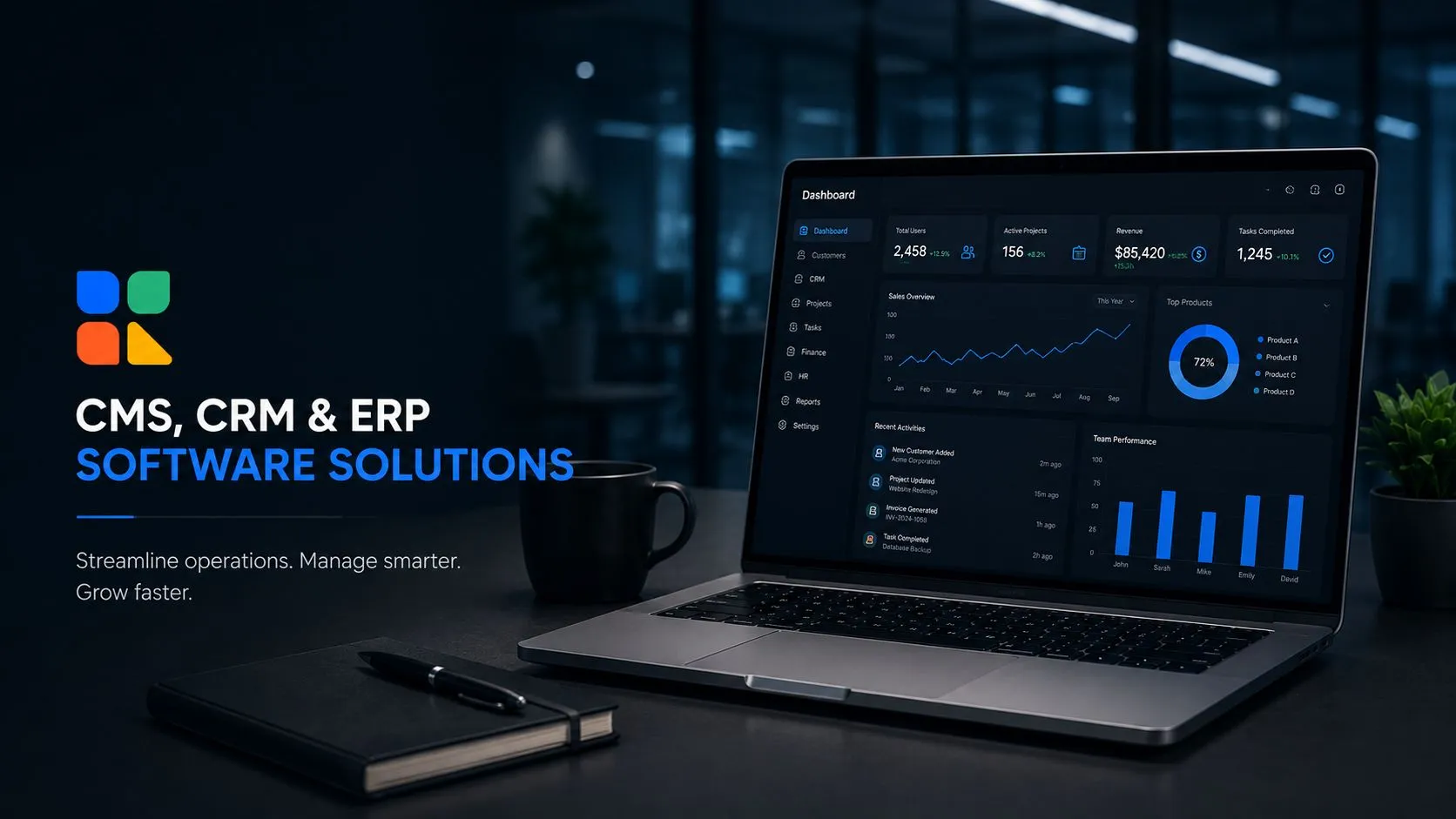
CRM, CMS and ERP platforms connected as one operating system
logo img
logo img
logo img
logo img
logo img
logo img
logo img
logo img
logo img
logo img
logo img
logo img
logo img
logo img
logo img
logo img
logo img
logo img
logo img
logo img
logo img
logo img
logo img
logo img
logo img
logo img
logo img
logo img
logo img
logo img
logo img
logo img
logo img
logo img
logo img
logo img
logo img
logo img
logo img
logo img

What Actually Goes Wrong With Business Systems

01

The CRM became a filing cabinet.

Licences were purchased for the whole commercial team. A portion of them log in. Records are incomplete because entering them takes longer than the sale is worth. The pipeline report goes to the board every month and everyone privately discounts it. No sales process was encoded, so the system records outcomes without influencing them.
02

The website needs a developer for every change.

The marketing team raises a ticket to update a headline. Landing pages take a fortnight because each one is built by hand. Content has no structure, so nothing can be reused across channels, and a second language or a second market means duplicating everything and watching it drift apart.
03

The ERP went live half-configured.

The implementation ran long, the budget ran out, and the decision was made to go live and finish later. Later did not arrive. Staff built spreadsheets to handle the parts that were never completed, and those spreadsheets are now load-bearing.
04

The systems were configured to preserve broken processes.

Rather than using the implementation to fix how work moves, the platform was bent to imitate the previous way of working. The organisation paid for a new system and kept the old inefficiency, with additional licensing cost attached.
05

Customisation has locked you out of upgrades.

Enough bespoke code was written into the platform that vendor updates now carry risk. Upgrades get deferred. Deferral compounds. Eventually you are running a version the vendor no longer supports well, and the modernisation cost exceeds what the original customisation saved.
06

Nobody owns the joins.

The CRM vendor is responsible for the CRM. The ERP partner is responsible for the ERP. The web agency is responsible for the site. When an order placed online fails to reach the finance system with the right customer reference, three suppliers each explain why it is not their component. The client is the integrator by default.
07

There is no single view of a customer.

Sales sees conversations. Finance sees invoices. The website sees behaviour. Support sees complaints. Joining those four views is a manual exercise, which means it happens for board packs and never for the daily decisions that would actually benefit from it.
08

Month-end takes longer than it should.

Closing the books requires exports, adjustments and reconciliation because the operational data was never trustworthy enough to close on directly. Finance spends its most valuable week doing assembly rather than analysis.
09

And the licence bill keeps arriving.

Renewal comes around for seats that are not used, modules that were never switched on, and tools that overlap with each other. Very few organisations have ever audited this properly.

Almost nobody regrets buying a CRM, a CMS or an ERP. What organisations regret is how the implementation was scoped, who was left to own it, and how little the three systems were ever asked to cooperate.

20+

Years of experience

5

Global Locations

300+

Active Clients

2%

Top HubSpot Partners Globally

100+

In-house Digital Marketing Specialists

How We Think About Business Systems

01

We start with the operating model, not the vendor shortlist.

Before any platform is discussed, we map how demand, delivery, content and cash actually move through your business, where the handovers are, and which of those handovers currently cost you money. Platform choice becomes a consequence of that picture rather than a decision made from a feature comparison.
02

We design the data architecture across all three systems at once.

Where the customer record lives, which system owns a product, how an order becomes an invoice, what identifier ties a web visitor to an account — these are decided once, deliberately, and applied consistently. Most integration pain later is the delayed consequence of never having made these decisions explicitly.
03

Configure first. Extend second. Customise last.

Every departure from standard platform behaviour is a permanent liability against future upgrades. We treat that liability as a cost with a number attached and argue it accordingly. Some customisation is genuinely worth it, and we will build it properly. Most of what gets requested in the first workshop is worth reconsidering once the standard capability is understood.
04

Selection is evidence-based and commercially neutral.

Our recommendation follows from your process complexity, transaction volume, compliance environment, internal capability and five-year cost of ownership. We are not incentivised to route you toward a particular licence, and we will tell you when your existing platform is capable of far more than you are currently using — which is frequently the case, and considerably cheaper than replacing it.
05

Adoption decides the return, not the go-live date.

A system is worth what people use it for. We involve the eventual users during design, phase the rollout so each group receives something that makes their week easier, and treat training, documentation and internal ownership as delivery scope rather than a closing formality.
06

We phase toward value.

Large single-cutover programmes concentrate risk at the worst possible moment. Wherever the operating model allows, we sequence delivery so a defined benefit lands early, funds confidence, and creates the internal momentum that carries the rest of the programme.
07

We stay accountable across the seams.

Because strategy, implementation, integration, content, data and marketing technology sit within one organisation, there is no gap between suppliers for problems to fall into. The joins are somebody’s job here.

Not sure whether to replace or extend what you already own?

Book a systems assessment. A significant proportion of the assessments we run conclude that the existing platform is capable of considerably more than the organisation currently uses.

Book a systems assessment

What We Deliver

1

Systems Assessment and Platform Selection

Structured evaluation of your current systems, processes and data, resulting in a recommended platform architecture and a costed implementation plan. The most expensive decisions in any systems programme are made before implementation begins, usually with the least information. Process and data audit, licence and cost review, requirement definition weighted by commercial impact, vendor evaluation against your real scenarios rather than generic demonstrations, and a total cost of ownership model covering licences, implementation, integration and support.
Influences
implementation risk licence spend whether the chosen platform still fits in three years
2

CRM Implementation and Revenue Operations

Configuration of the customer platform around your actual commercial process — pipeline stages, qualification criteria, activity capture, territory and ownership rules, quoting, forecasting and reporting. A CRM that records history is an administrative burden. A CRM that guides the next action becomes the way the commercial team works. We encode your sales process into the system so the platform prompts rather than merely stores, reduce required data entry to the fields that genuinely inform a decision, automate capture wherever it can be automated, and design reporting that leadership can act on. Where marketing automation is in scope, we connect lead capture, scoring, nurture and handover so the same definitions apply on both sides — including CRM and email marketing programmes.
Influences
pipeline visibility forecast accuracy sales cycle length lead response time conversion at each stage
3

CMS and Digital Experience Platforms

Content platforms your marketing team can operate independently, structured for reuse across sites, markets, languages and channels. Speed to publish is a competitive capability. Every campaign that waits on a development queue is a campaign losing relevance. We model content as structured, reusable components rather than pages of formatted text, build a governed component library so non-technical editors can compose new pages safely, and design editorial workflow, permissions and approval to match how your team is organised. Headless, hybrid and traditional architectures are each appropriate in different circumstances, and we select based on your channel requirements and internal skills rather than on category fashion. This sits alongside website design and development.
Influences
time from brief to published developer dependency localisation lead time page performance organic visibility
4

ERP Implementation and Process Configuration

Configuration of the operational and financial core — finance, procurement, inventory, production, order management, projects and reporting — around a deliberately designed process. The ERP determines how quickly you can close the books, how much stock you must hold, and how confidently you can quote a delivery date. We redesign the process before configuring the system, so the implementation delivers an improvement rather than a migration of existing habits. Chart of accounts, cost structures, item and partner master data and approval hierarchies are designed with finance and operations together. Multi-entity, multi-currency and multi-location complexity is addressed in the design phase, where it is manageable.
Influences
close cycle duration inventory accuracy order-to-cash time working capital reliability of operational reporting
5

Integration Architecture

The connective layer between CRM, CMS, ERP, commerce, payments, logistics, support and identity systems. The value of the individual platforms is largely determined by how well they exchange information. This is the layer that most programmes underfund. A defined system of record for each data domain, explicit contracts between systems, event-driven or scheduled synchronisation chosen per case, idempotent handling so retries do not duplicate records, and monitoring that surfaces a failed exchange immediately rather than through a variance discovered at month-end.
Influences
data consistency elimination of duplicate entry reporting speed operational resilience
6

Master Data and Migration

Cleansing, structuring, deduplicating and migrating the data that will populate the new environment, plus the governance that keeps it clean afterwards. Migrated poor data destroys confidence in a new system within weeks, and confidence is difficult to recover once lost. Early profiling to expose quality problems while there is time to act, agreed rules for deduplication and enrichment, rehearsed migration runs with reconciliation reporting, and ownership assigned for each data domain so quality does not degrade again after go-live.
Influences
trust in reporting duplicate rate the speed at which teams stop maintaining shadow spreadsheets
7

Custom Modules, Extensions and Connectors

Purpose-built functionality where standard platform capability genuinely cannot meet a requirement that matters commercially. Every business has some process it should not standardise, usually the one it competes on. Built against supported extension points rather than by modifying core behaviour, documented, tested, and reviewed at each platform upgrade. We record the reason a customisation exists so future teams can judge whether it still earns its maintenance cost. Larger custom builds sit with software development.
Influences
process fit without loss of upgrade path long-term maintainability
8

Reporting, Dashboards and Business Intelligence

The reporting layer drawing across systems to answer the questions leadership actually asks. Systems that cannot report usefully get bypassed, and the organisation returns to spreadsheets it trusts more. We start from the decisions being made — pricing, stock, hiring, spend, prioritisation — and work backwards to the data required, rather than publishing whatever the platform reports by default. Definitions are agreed in writing so revenue, margin and pipeline mean the same thing in every meeting.
Influences
decision speed forecast reliability the volume of manual analysis being performed
9

Automation and AI Across the Stack

Removing manual handling from the workflows that cross these systems — document and invoice processing, data enrichment, lead routing and scoring, content generation within governed templates, service triage and predictive prompts inside the interface. The seams between systems are where manual effort concentrates, which makes them the highest-return place to automate. We fix and simplify the process before automating it, apply deterministic rules where rules are sufficient, keep human review at the points where an error is consequential, and measure accuracy against a defined baseline before anything is relied upon. See AI and automation solutions.
Influences
recovered staff capacity transaction cost turnaround time error rates
10

Training, Adoption and Change Enablement

The structured work of moving an organisation from the old way of working to the new one. This is the difference between a system that transforms the operation and one that becomes a data entry obligation resented by the people expected to maintain it. Role-based training rather than a general session, documentation written for the task instead of the feature, internal champions identified and supported, floor presence during the first operational cycles, and usage monitored so the teams that are struggling receive attention before habits set.
Influences
active usage rate data completeness the speed at which benefits actually materialise
11

Support, Optimisation and Licence Governance

Ongoing operation and continuing improvement of the platform estate after go-live. Implementations deliver a fraction of available value at launch. The remainder is unlocked over the following years, provided somebody is looking for it. Defined support commitments, managed upgrade cycles that keep you on supported versions, a prioritised improvement backlog reviewed on a regular cadence, and periodic licence and utilisation review so you stop paying for capacity nobody uses.

Influences
total cost of ownership platform currency the rate of continued return on the original investment

The BrandReturns Implementation Path

01 — Assess
  • 1 Current systems, processes, data quality, licences and commercial objectives examined
  • 2 We speak to the people operating the process daily, not only the sponsors
02 — Define
  • 1 Future operating model designed before any platform decision is confirmed
  • 2 Requirements weighted by commercial impact so trade-offs are made on the right basis
03 — Select
  • 1 Options evaluated against your own scenarios, with five-year cost of ownership
  • 2 Keeping and extending what you already own presented with equal weight
04 — Design
  • 1 Configuration, integration, data model, migration and reporting signed off
  • 2 Customisation register with each item justified before build begins
05 — Configure and Extend
  • 1 Iterative cycles with your team reviewing working functionality in a real environment
  • 2 Extensions and connectors built against supported interfaces, not slides
06 — Migrate
  • 1 Data profiled, cleansed, mapped and loaded through rehearsed runs
  • 2 Live migration is a procedure that has already been performed several times
07 — Validate
  • 1 End-to-end process testing across connected systems, not module by module
  • 2 User acceptance conducted by the people who will operate the system
08 — Enable
  • 1 Role-based training, task-oriented documentation and champion enablement
  • 2 Go-live is a decision made on evidence, not on a date fixed months earlier
09 — Go Live and Stabilise
  • 1 Controlled cutover with a defined fallback position and hypercare support
  • 2 Actual usage monitored by team and role while attention is still high
10 — Optimise
  • 1 Review against the outcomes defined at the start
  • 2 Unused capability activated, licence position reviewed, roadmap prioritised with you

The path adapts to the engagement. An ERP programme in a regulated or multi-entity environment weights design, migration and validation heavily. A CMS replatform compresses selection and concentrates on content modelling, migration and search continuity. A CRM rollout lives or dies on the enable stage. The sequence is a discipline rather than a fixed template.

A platform decision already on the table?

Request a platform selection review against your own scenarios and get a defensible recommendation with the costs and risks stated openly.

Request a platform selection review

Why BrandReturns

01

We hold all three systems in one view.

Most suppliers are specialists in one platform category and treat the others as someone else’s boundary. We design the CRM, CMS and ERP relationship deliberately, which is where the compounding value in this category actually sits.
02

Our recommendation is not shaped by a licence incentive.

We are paid to design and implement the right system, not to move a particular product. That includes recommending you keep and extend what you already own when the evidence supports it.
03

We argue against customisation until it is proven necessary.

Saying no to a request in a design workshop is uncomfortable and correct. Protecting your upgrade path is one of the more valuable things a partner can do, and it rarely appears on a proposal.
04

Commercial and technical fluency in the same conversation.

Programmes stall when technical decisions cannot be justified to finance and commercial decisions cannot be translated into configuration. Both sides of that conversation happen internally here before anything reaches you.
05

We plan for adoption as seriously as for build.

Enablement, training, documentation and post-launch support are scoped, resourced and costed from the beginning rather than compressed at the end when the budget is under pressure.
06

The joins are our responsibility.

Integration failures, data mismatches and process gaps between platforms are within scope rather than between suppliers. There is one number to call.
07

Everything is documented and yours.

Configuration decisions, integration specifications, data dictionaries, customisation registers and runbooks are delivered as the work proceeds. Your platform accounts, environments, code and data belong to you, structured so another team could take over cleanly.

Industries We Work With

The implementation path is consistent; the emphasis and the difficult parts change by sector.

Distribution and wholesale

Inventory accuracy, pricing structures, multi-warehouse operations and the order-to-cash cycle. ERP configuration dominates, with CRM connected to the same customer and pricing master data.

Manufacturing

Bills of material, production planning, costing and traceability, with the integration between shop floor systems and the enterprise core doing most of the heavy lifting.

Retail and e-commerce

The connection between storefront, content, inventory, fulfilment and finance. This is the sector where CRM, CMS and ERP most obviously need to behave as one system.

Professional and B2B services

Opportunity-to-engagement flow, resourcing, project accounting, time capture and billing. CRM and ERP overlap heavily and the boundary must be drawn deliberately.

Financial services

Access control, audit trails, consent and communication records, and regulatory reporting. Configuration decisions carry compliance consequences.

Healthcare and clinical services

Sensitive data handling, permission governance and interoperability with clinical systems, where assurance requirements shape both design and timeline.

Education and training providers

Enquiry-to-enrolment pipelines, learner records, content delivery and reporting to internal and external stakeholders.

Property and construction

Project accounting, cost control, asset and maintenance records, and enquiry management across a long, multi-touch sales cycle.

Logistics and field operations

Job scheduling, mobile data capture and the reconciliation between field activity and the finance core.

Media, publishing and content-led organisations

Content modelling at scale, multi-market and multi-language governance, and the relationship between audience data and commercial systems.

Work That Moves Businesses Forward

Different industries. Different challenges. One principle: every strategy must create meaningful business value.

Luxury & Lifestyle case study
Luxury & Lifestyle

From Product to Desire

We transformed the brand's positioning through a refined identity, compelling storytelling and premium digital experiences—turning products into something audiences aspire to own.

  • Brand Strategy
  • Creative Direction
  • Social Media
  • Digital Marketing
View Case Study
Real Estate case study
Real Estate

Turning Developments Into Destinations

We connected premium positioning with digital campaigns and targeted lead generation—creating a stronger market presence and a clearer path from interest to inquiry.

  • Branding
  • Digital Strategy
  • Lead Generation
  • Performance Marketing
View Case Study
Automotive case study
Automotive

Driving Attention Into Action

We combined powerful creative, digital storytelling and performance marketing to strengthen brand consideration and turn audience attention into meaningful opportunities.

  • Creative Campaigns
  • Social Media
  • Content
  • Performance Marketing
View Case Study
Healthcare case study
Healthcare

Building Trust in a Digital-First World

We simplified complex services into a clear and credible brand experience—helping audiences understand the offering, build confidence and take the next step.

  • Brand Strategy
  • Website
  • Content
  • Digital Marketing
View Case Study
Technology case study
Technology

Making Innovation Easier to Buy

We transformed technical capabilities into a compelling commercial story, creating sharper positioning and a digital journey designed around modern B2B decision-makers.

  • Positioning
  • Website
  • B2B Marketing
  • Lead Generation
View Case Study
Hospitality case study
Hospitality

From Experience to Destination Brand

We brought the experience to life digitally through distinctive storytelling, content and campaigns designed to inspire discovery, engagement and bookings.

  • Brand Strategy
  • Content Creation
  • Social Media
  • Digital Campaigns
View Case Study
E-Commerce case study
E-Commerce

Turning Traffic Into Revenue

We connected customer acquisition, creative, conversion optimization and retention into one performance-focused ecosystem built to turn more visitors into customers.

  • Performance Marketing
  • E-Commerce
  • CRO
  • Retention Strategy
View Case Study
Financial Services case study
Financial Services

Making Confidence the Brand

We strengthened positioning and digital communication around what matters most in financial services—credibility, clarity and customer confidence.

  • Brand Strategy
  • Digital Experience
  • Content
  • Performance Marketing
View Case Study

Your Business Could Be Our Next Growth Story.

Every ambitious business has a challenge worth solving. Bring us yours, and let's discover what strategy, creativity and technology can achieve together.

Start Your Project

Systems programmes are frequently judged on whether the go-live date was met. That measures project management. It does not measure whether the investment was worth making. We define commercial measures during assessment, baseline them before implementation, and report against them afterwards.

Results and Measurement

01

CRM and commercial performance

  • Active usage rate among the licensed commercial team
  • Data completeness on the fields that inform decisions
  • Forecast accuracy against actual closed revenue
  • Lead response time and lead-to-opportunity conversion
  • Sales cycle length and stage-by-stage conversion
  • Pipeline attributable to marketing activity, defined consistently on both sides
  • Customer retention and revenue from existing accounts
02

CMS and digital experience

  • Time from brief to published page or campaign
  • Development tickets raised for content changes, and their trend
  • Content components reused across pages, markets and channels
  • Localisation lead time for an additional language or region
  • Page performance and Core Web Vitals on key templates
  • Organic visibility retained through a replatform, measured against pre-migration baseline
  • Conversion rate on primary templates
03

ERP and operational performance

  • Month-end and year-end close duration
  • Inventory accuracy and stock-holding value
  • Order-to-cash cycle time and days sales outstanding
  • On-time and in-full delivery performance
  • Manual journal entries and adjustment volume
  • Error and rework rates in core transactions
  • Cost per order, transaction or case processed
04

Across the estate

  • Completeness of the single customer view across systems
  • Integration failure rate and time to detection
  • Manual hours removed from reconciliation and duplicate entry
  • Licence utilisation against licence spend
  • Total cost of ownership against the pre-implementation baseline
  • Currency of platform versions and upgrade cadence maintained

We will not quote a percentage improvement before measuring your baseline, and we do not use invented industry averages to justify a business case. What we commit to is establishing the baseline honestly, agreeing the targets with you, and reporting against them including when the news is unwelcome.

Frequently Asked Questions

1. Should we adopt a single vendor suite or choose best-of-breed systems and integrate them?
Suites reduce integration effort and give you one commercial relationship, at the cost of accepting a weaker module in at least one area. Best-of-breed gives you the strongest capability in each category and makes the integration layer your responsibility. The right answer depends on where your genuine complexity sits, the maturity of your internal technical capability and your appetite for managing multiple vendors. We assess this during the definition stage rather than arriving with a fixed position.
2. How much should we customise the platform?
As little as the commercial requirement allows. Every customisation is a permanent cost applied against every future upgrade, and unrestrained customisation is the most common reason organisations end up stranded on unsupported versions. We maintain a customisation register through design, with a written justification for each entry, and we will challenge requests where standard capability or a small process change would serve you as well.
3. How long does an implementation take?
It varies substantially by category and complexity. A CRM rollout for a defined commercial team moves faster than a multi-entity ERP programme, and a CMS replatform sits between the two depending on content volume and migration requirements. The variables that matter most are the number of integrations, data quality, the extent of process redesign, and the availability of your subject matter experts. We give an indicative range after assessment and a firm plan after design.
4. What drives the cost?
Four things, in roughly this order: the extent of process redesign and configuration, integration complexity, data migration and cleansing, and change enablement. Licence cost is usually the most visible line and rarely the largest. We model total cost of ownership across five years so licences, implementation, integration and support are all visible in the decision rather than emerging afterwards.
5. Do we necessarily have to replace what we already have?
Often not. A significant proportion of the assessments we run conclude that the existing platform is capable of considerably more than the organisation currently uses, and that the real problems are configuration, data quality, process and adoption. Extending what you own is usually faster and cheaper than replacing it, and we will present that conclusion where it is the right one.
6. How do you handle our existing data?
As a workstream beginning during assessment rather than shortly before go-live. Source data is profiled early so quality problems surface while there is time to resolve them. Deduplication, enrichment and mapping rules are agreed explicitly, migrations are rehearsed with reconciliation reporting at each pass, and ownership is assigned per data domain so quality is maintained after launch rather than degrading again.
7. How do you make sure our teams actually use the system?
By designing with them and phasing for them. Users participate in design sessions and review working configuration throughout. Rollout is sequenced so each group receives something that makes their work easier rather than something that adds administration. Training is role-based, documentation is written around tasks, internal champions are supported, and we monitor real usage after launch so struggling teams get help before workarounds become habits.
8. Can the programme be phased, or does everything have to move at once?
Wherever the operating model permits, we phase it. Concentrating all change into a single cutover concentrates all risk into a single weekend. Phasing lets a defined benefit land early, builds internal confidence, and keeps the organisation absorbing change at a rate it can sustain. Some financial and inventory transitions genuinely require a clean cutover, and where that is the case we plan and rehearse accordingly.
9. What happens after go-live?
A stabilisation period with intensive support, then a continuing arrangement covering defined response commitments, managed platform upgrades, a prioritised improvement backlog reviewed with you regularly, and periodic licence and utilisation review. The largest share of value in these platforms is realised in the years after implementation, and only if someone is actively looking for it.

Start With What the Systems Are Costing You

You do not need a platform decision to begin this conversation. You need a clear account of where the current estate is leaking time, money and confidence — the reconciliation that shouldn’t exist, the report nobody trusts, the process that runs on a spreadsheet somebody maintains privately. Bring that. We will bring a considered view on whether the answer is a new platform, a better configuration of the one you own, or the integration work that nobody has been willing to take responsibility for.

Book a systems assessment

Share where the current estate is leaking time, money and confidence. We'll come back with whether the answer is a new platform, a better configuration of the one you own, or the integration work nobody has owned.

United States

BrandReturns Global LLC

Wyoming, United States

Corporate Address

30 N Gould St
Ste R
Sheridan, WY 82801
United States

Phone

+1 646-347-1661

Email

info@brandreturnsglobal.com

Tell Us About Your Project

By submitting this form, you agree that BrandReturns may use the information provided to respond to your enquiry and communicate with you about relevant services. Your information will be handled in accordance with our Privacy Policy.

WhatsApp